
Let me be straight with you — most plumbing problems don't sneak up on you. You just ignore them. The drip you've been meaning to fix for six months. The toilet that runs every now and then. The shower pressure that's been slowly getting worse. According to the EPA, the average household leaks about 10,000 gallons of water every year — not from catastrophic pipe failures, but from small stuff that never got fixed. I've seen homeowners spend $8,000 on water damage repairs that started as a $15 washer. If you're in the DFW area and something feels off, call a trusted plumber in Coppell before that small thing becomes a story you're telling your insurance agent.
Why Does the Same Problem Keep Coming Back?
Because most people fix the symptom and walk away. The toilet clogs, you plunge it, done. Two weeks later, same thing. That's not bad luck — that's the same partial blockage still sitting in your drain line, just moved enough to flush once.
Real fixes address the cause, not just the result. And honestly, most causes aren't that complicated once you know what to look for.
Before we get into all 13, here's one thing worth doing right now: read up on how to prevent water leaks in your home. Most serious plumbing damage — the kind that warps floors and grows mold inside walls — starts as a slow drip that nobody caught. Prevention is genuinely cheaper than repair, every single time.
The 13 Problems, What Actually Causes Them, and What to Do
Problem 1: Dripping Faucets
A faucet dripping once per second wastes over 3,000 gallons a year. That's the EPA's number. Not an estimate — a measurement. Most people know their faucet drips. Most people also don't fix it for way too long.
The cause is almost always a worn washer, O-ring, or cartridge. These are tiny rubber or plastic parts that create a seal when the faucet is off. They wear out. That's it.
What works: Replacing the washer or cartridge. Most faucet repairs cost $10–$20 in parts and 20 minutes of your time.
What doesn't work: Cranking the handle tighter. I know it feels like it helps. It doesn't — it just grinds the washer down faster and makes the repair more expensive later.
Problem 2: Running Toilets
That hiss coming from your toilet tank after it's already refilled? That's water running continuously into the bowl. The EPA says it can waste 200 gallons a day. Per day.
Most of the time it's the flapper — the rubber seal at the bottom of the tank. It goes soft and warped over time, especially with hard water. A new one costs $6 at any hardware store and takes about 10 minutes to swap.
If a new flapper doesn't fix it, the fill valve or float arm is probably the issue. That's still usually a $15–$25 part. The mistake people make is replacing the flapper and assuming they're done, when the real problem is the fill valve slowly letting water in all along.
Problem 3: Slow or Clogged Drains
One slow drain? Probably a local clog — hair, soap, grease, whatever. One of those plastic zip-it tools from the hardware store ($3–$5) pulls out more hair than you want to see, and the drain runs fine again.
Multiple slow drains at the same time? That's your main sewer line. Different situation entirely.
Here's how to tell the difference: if you flush the toilet and water bubbles up in the shower drain, that's sewer line. If your kitchen sink gurgles when the washing machine drains, that's sewer line. If only the bathroom sink is slow, that's probably just a local clog.
My honest opinion on liquid drain cleaners: skip them for regular use. They work short-term but eat at older pipe interiors over years of use. A drain snake does the job without the damage.
Problem 4: Low Water Pressure
Weak pressure at one faucet is usually a clogged aerator — unscrew the tip of the faucet, rinse out the small screen inside, and put it back. Pressure returns. Five minutes total.
Weak pressure throughout the whole house is different. In older Coppell-area homes, especially anything built before the mid-1980s, galvanized steel pipes are sometimes still in place. They corrode from the inside out over decades, slowly narrowing until the flow is almost nothing. The outside looks fine. The inside looks like a clogged artery.
If your pressure has been slowly dropping for years — not a sudden change, but a gradual fade — that's usually pipe corrosion. A plumber can test your pressure levels (normal is 40–80 PSI) and tell you whether it's a quick fix or a repiping conversation.
Problem 5: Water Heater Issues
Here's my personal take: the water heater is the most neglected appliance in most homes. People replace refrigerators, washing machines, even HVAC systems — but the water heater sits in a closet or garage, gets ignored for 12 years, and then fails on the coldest morning of the year.
Most units last 8–12 years. In North Texas, hard water shortens that lifespan because mineral sediment builds up at the bottom of the tank, insulating the water from the heating element and making the unit work harder than it should.
Signs it's struggling:
Hot water runs out faster than it used to
Rumbling or popping while it heats (that's sediment)
Rust-colored water from hot taps only
Moisture or corrosion around the base
Flushing the tank once a year clears the sediment and adds years to the unit's life. It takes a plumber about 30 minutes. Most homeowners never do it once.
Problem 6: Leaky Pipes
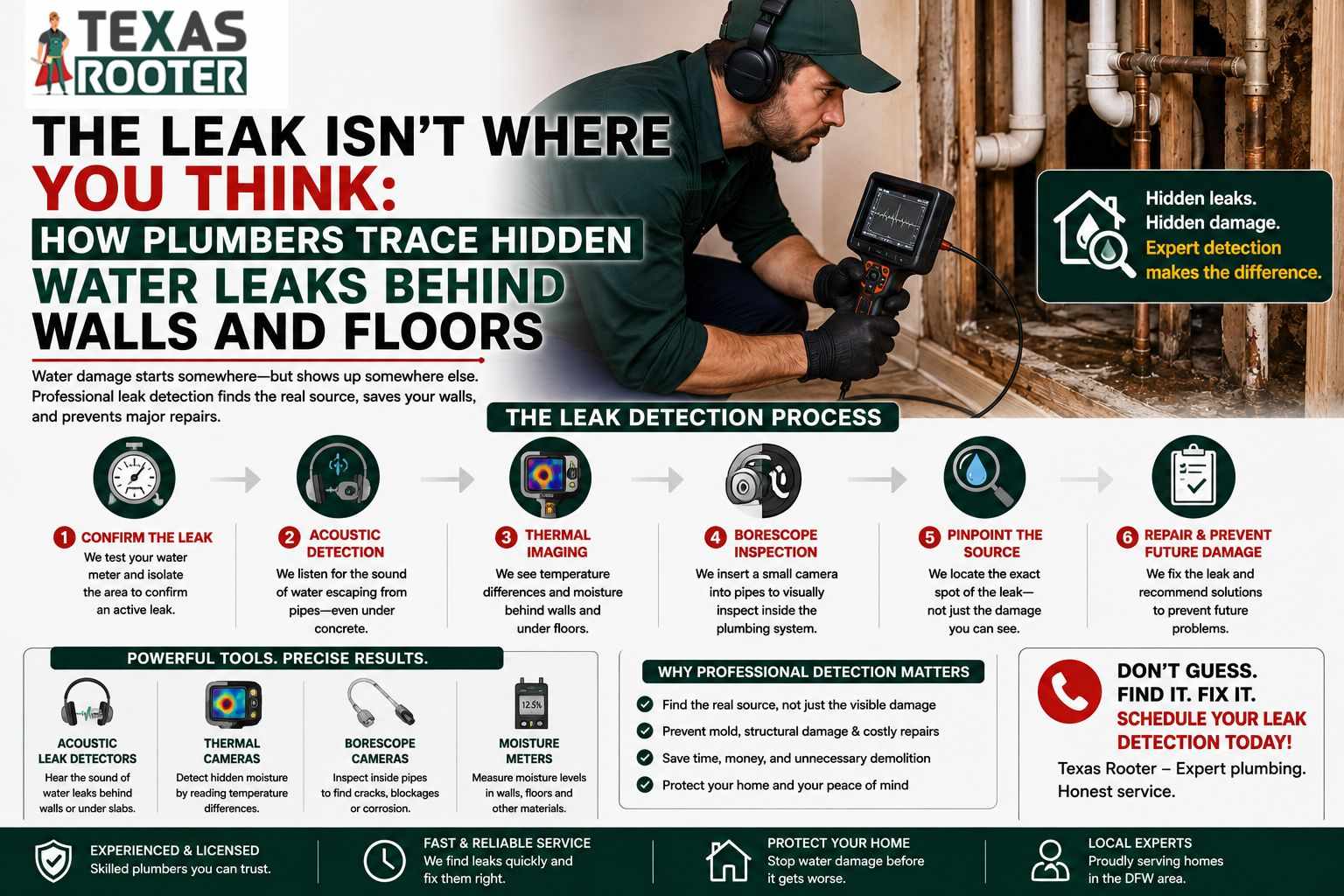
Leaky pipes are sneaky because the ones that cause the most damage are the ones you can't see. A pinhole leak inside a wall drips quietly for months. By the time you notice a soft spot in the floor or a stain spreading across the ceiling, there's already mold growing somewhere you can't reach without cutting drywall.
The early signs are subtle: a water bill that keeps climbing without explanation, a faint musty smell in one room, paint that bubbles slightly on an interior wall. Take those signals seriously.
What works: Calling a plumber early and getting a pressure test or thermal imaging scan. They can find the leak without opening walls in most cases.
What doesn't work: Waiting until you can see the damage. By then, you're not just fixing a pipe — you're fixing a pipe plus mold remediation plus drywall plus possibly flooring.
Problem 7: Garbage Disposal Jams
Most people assume the disposal is dead when it hums but doesn't spin, or when it doesn't respond at all. Usually it's just jammed or tripped.
Reset steps that actually work:
Turn off the switch completely
Find the small red or black reset button on the bottom of the unit under the sink — press it
Use the hex/Allen wrench in the center port on the bottom to manually rotate the grinding plate back and forth
Run cold water and try the switch
That fixes probably 70% of "dead" disposals. If it still doesn't work after that, the grinding plate is genuinely seized, or the motor is done.
What people do wrong: Pour water down while it's jammed and keep hitting the switch. That doesn't free anything — it just trips the thermal overload again, and you're back to square one.
Problem 8: Sewer Line Backups
This is the worst one on the list. Not because it's always the most expensive — though it can be — but because of what it involves. Sewage in your floor drain. Toilets that bubble when you run the kitchen sink. A smell in the basement that doesn't go away.
Main sewer line problems come from a few things: tree roots growing into the pipe joints (extremely common in established neighborhoods), grease buildup over years, a section of pipe that's cracked or collapsed, or just old clay pipe that's reached the end of its life.
A sewer camera inspection is the only real way to know what's happening. It takes about an hour, costs $150–$300, and shows you exactly what's in the line. No guessing, no exploratory digging. Get the scope first, then decide on repairs.
Problem 9: Pipe Corrosion
Corrosion is a slow killer. Here's what to look for on pipes you can actually see — basement, crawl space, under sinks:
Blue-green staining around copper joints = active corrosion
Orange or rust-colored residue = galvanized pipe deteriorating
White or chalky buildup = mineral scale, common with hard water
Here's a straight breakdown of what you've got and what it means:

If your home has polybutylene pipe — that gray plastic stuff used from roughly 1975 to 1995 — I'll be direct: replace it. It doesn't matter if it hasn't failed yet. It will. And when it does, it usually fails fast and completely, not slowly with a warning drip.
Problem 10: Toilet Clogs
A flange plunger works. A flat cup plunger doesn't do much in a toilet — the rubber lip needs to extend down into the drain opening to build actual suction. That's the flange plunger.
If plunging doesn't clear it in a few tries, a toilet auger (closet snake) reaches further down the trap. Most hardware stores rent them.
If your toilet clogs regularly with normal use, the clog isn't really the problem — something else is. Either there's a partial obstruction further down the drain line that keeps catching things, or the toilet itself is an older low-flush model that doesn't have the power to move waste through your home's drain configuration.
Problem 11: Noisy Pipes
Pipes shouldn't make noise. When they do, here's what's usually happening:
Loud bang when water shuts off: Water hammer. The pressure wave from flow stopping suddenly slams through the pipe. A water hammer arrestor (about $15) absorbs the shock.
Hissing inside a wall: A supply line leak under pressure. Don't ignore this — it's actively dripping somewhere you can't see.
Rattling while water runs: Loose pipe straps. The pipe vibrates against framing. Usually a quick fix.
Groaning at night when no water is running: Thermal expansion in copper pipes. Often harmless, but worth mentioning to a plumber if it's new.
None of these are sounds you just live with indefinitely. They're all telling you something.
Problem 12: Leaking Washing Machine Hoses
This one doesn't get talked about enough. The rubber hoses connecting your washing machine to the wall are under constant water pressure — 24 hours a day, 7 days a week, even when the machine isn't running. They degrade. When they fail, they don't drip — they burst. And a burst washer hose can dump hundreds of gallons into your laundry room before anyone notices.
What actually works: Swap the rubber hoses for braided stainless steel ones. They cost about $20 for a pair and take 10 minutes to install. Do it every 5 years regardless of how they look.
Also — if you're leaving for a week or more, turn off the supply valves behind the machine. It's a simple habit that's prevented a lot of very bad days.
Problem 13: Frozen Pipes
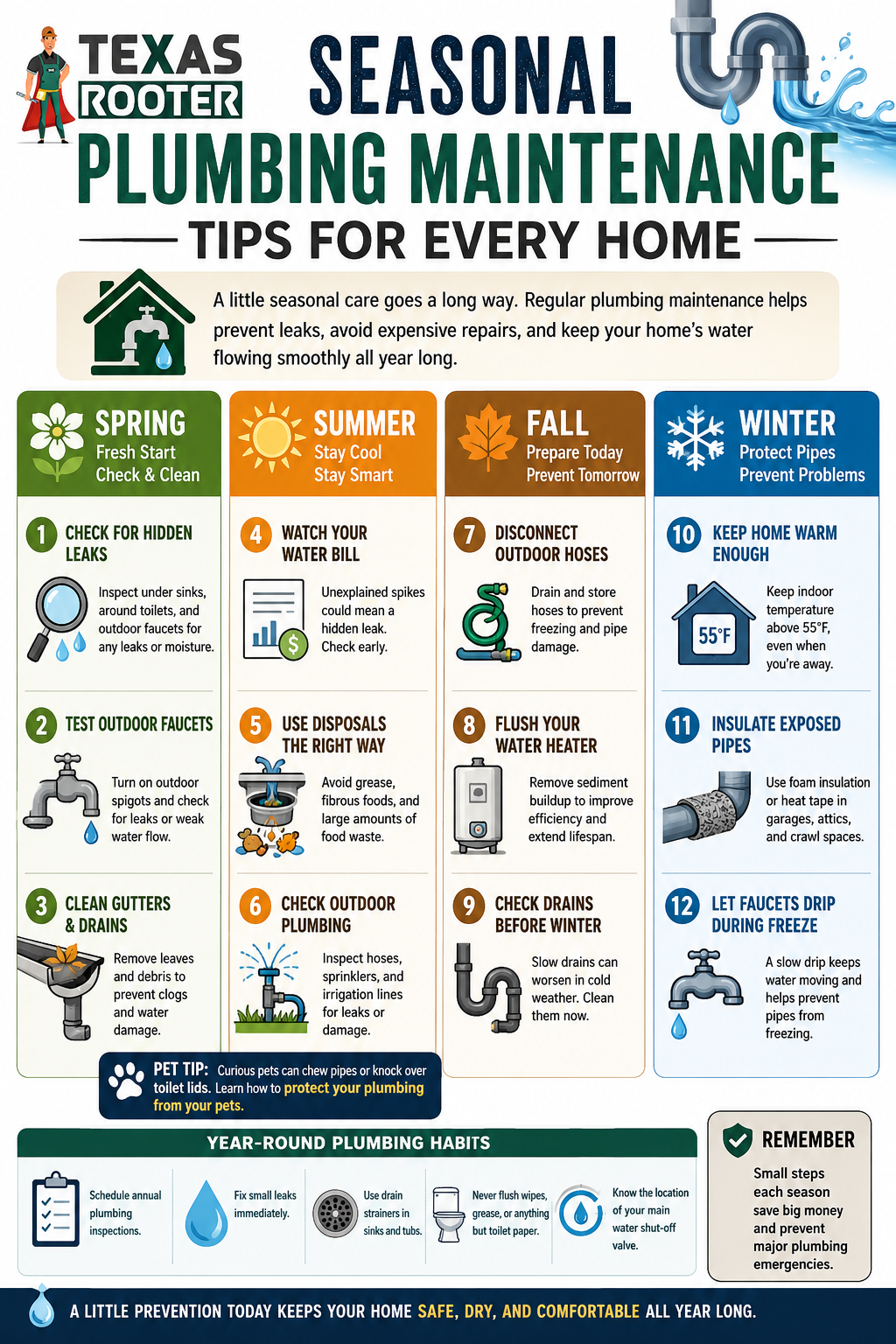
Texas doesn't freeze hard very often — but when it does, it hits homes that were never designed or insulated for serious cold. We saw this play out badly in 2021. Pipes in exterior walls, unheated garages, and crawl spaces burst because nobody anticipated temperatures that low.
Before a forecast freeze:
Wrap exposed pipes in foam insulation — it's cheap and takes 20 minutes
Let faucets on exterior walls drip slightly overnight — moving water is harder to freeze
Know exactly where your main shut-off valve is before you need it in a panic
If a pipe freezes, a hair dryer on low heat works fine to thaw it. Never use an open flame. And if you hear a pop or crack, or if water starts coming out when it thaws — shut off the main immediately and call a plumber. A cracked pipe can look fine until it fully thaws and then lets loose.
DIY or Call a Plumber? Here's the Honest Version

The general rule: anything involving your main supply line, sewer line, water heater, or water you can already see coming out of walls or floors — that's a licensed plumber call. The small fixture stuff is usually manageable on your own.
One Last Thing
Plumbing problems don't respect timing. They don't wait for a convenient week or a paycheck. But most of them do give warnings — sometimes for months — before they turn into real emergencies. The homeowners who end up with the big repair bills are usually the ones who noticed something and put off dealing with it.
If your home is in the Coppell area and you've been putting something off, Texas Rooter can help. We do full inspections, leak detection, drain cleaning, water heater service, sewer scopes, and emergency repairs. Get a plumber in Coppell in before the problem decides it's done waiting.
Key Takeaways
Dripping faucets and running toilets waste thousands of gallons a year — the fix is almost always cheap
One slow drain is a clog; multiple slow drains is a sewer line problem — treat them differently
Polybutylene pipes need to go — replace them before they make the decision for you
Water heaters need annual flushing — especially in hard water areas like North Texas
Washing machine hoses burst without warning — $20 braided hoses every 5 years is cheap insurance
Noisy pipes are always worth investigating — they're never just background noise
Frozen pipe risk is real in Texas — prep before the forecast, not during it
Know your main shut-off valve location — you'll thank yourself when the time comes


Write a comment ...